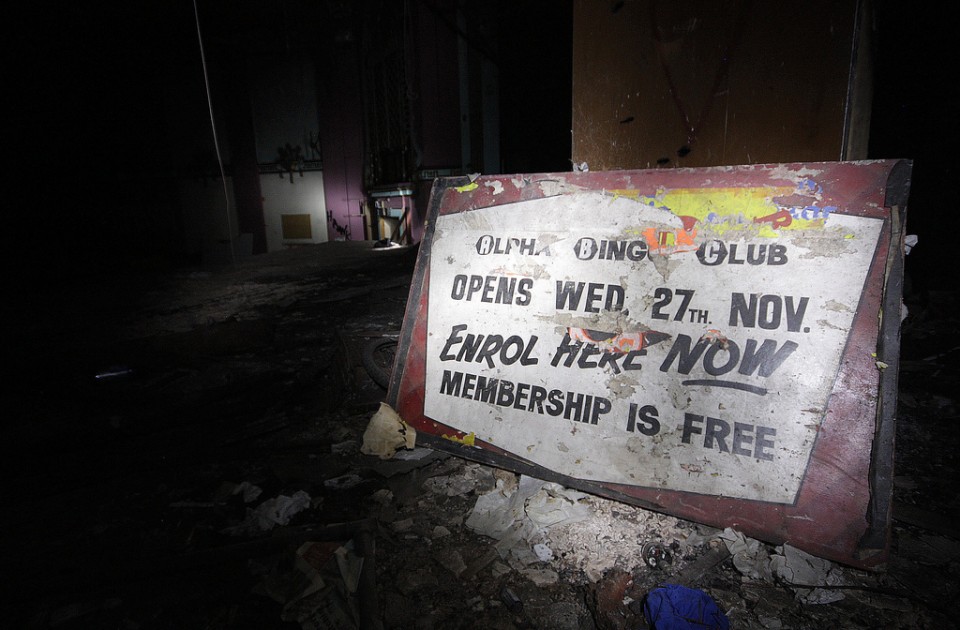
The spooky asylum, the creepy mansion, the post-apocalyptic bingo hall; the horror genre is replete with all manner of settings whose only purpose, like a modern-day job centre, is to deaden the soul and shrivel the spirit. While setting plays an incarnate role in many genres, horror itself seems particularly reliant on location to achieve its effects. ‘The Abduction Door’[i] is arguably one of the most successful horror stories in the New Fears[ii] collection, and I would argue this is to do with its application of location; and how the setting exerts itself as an existential threat to the protagonist and, by extension, the reader.
Manuel Aquirre writes that
at the heart of the literature of terror lies one ruling symbol. It manifests itself in haunted buildings, in labyrinths and prisons, catacombs and caves; in borders and frontiers, thresholds and walls; in the terror of the shuttered room and the protection of the magic circle; in the promise and dread of the closed door; in journeys of discovery, feats of transgression and flight from retribution. The world is designed in horror literature as space and, furthermore, as a closed space.[iii]
The space in horror ‘begins and will predictably end with a confrontation of this space by man…as manifested in man’s…persecution by evil, the Alien, the Other.’[iv] In other words, a horror setting is only such if it threatens the self and corrupts the ontological faculties of its victims. For instance, it is not the abduction door itself, not the realm beyond it, that imbues the protagonist and therefore the story with terror. Tellingly, as a child, the protagonist isn’t scared of the door because ‘with the first glimpse [of the door] [he] felt only curiosity.’[v] It’s only when Cyril, the hotel bellman, explains how ‘kids got snatched right in the middle of their elevator rides…sometimes grownups, too’[vi], does the protagonist respond with fear and forget to breathe.[vii] This may seem like an obvious proposition, but it is worth stating that the fear of the abduction door is generated once it is understood as a threat to the self. This examination lays the groundwork for understanding why some locations in horror literature are so ubiquitous.
Few locations, for instance, are as abundant as the haunted house.[viii] Yet the home, a place of human sanctuary, should be the least on a list of places of terror. However, it must be understood that this setting works as a staple of horror because the external landscape is ‘central to the search for human identity, the extension of self and society through conquest’[ix]. The hostile presence of the Other within a home, a place of human sanctuary, threatens not only the safety of the houses’ occupants, but their very being and identity, as ‘it is in terms of such otherness that our own identities consolidate and dissolve’.[x] The haunted house is, ultimately, a symbol of terror because ‘it is no longer a human space; it does not happen to be sheltering a numinous [that which transcends the rational] presence, it is the numinous presence, an otherworldly living space that craves birth, sustenance, growth, reproduction in the human world. It is another perfect parasite, another cell in the body of mankind which has been transmuted into a part of the Enemy.’[xi] In other words, it is through the reduction of the human, and the self by extension, that the horror location generates its capacity for terror.
The realm beyond the abduction door could be considered a form of the haunted house, especially with its eerily similar make-up of ‘narrow corridors and strangely angled doors’[xii]. It asserts itself on the ‘human world’ of the protagonist by stealing his daughter. Understandably, this causes a stripping away of his identity: ‘She’s been taken and the only part of me that’s left is the animal part.’[xiii] His very identity dissolves from the incursion of the abduction door. Moreover, at the story’s conclusion, he is faced with the dilemma that he must become a kidnapper himself to return to his daughter. He must become akin to the other former human ‘monsters’ that stalk the realm beyond the abduction door, stealing other people’s children’[xiv]. His humanity itself is under threat of invasion. He is caught in the ontological paradox of needing to surrender his humanity[xv] in order to regain his humanity.
‘Fear’, writes Sartre, arises ‘when the world of the utilisable vanishes abruptly and the world of magic appears in its place’[xvi]. Yet the magical realms of Hogwarts and Narnia do not inspire terror as much as wonderment. But these worlds are not framed as incursions on the human world; more as extensions of it. It is, arguably, the incursion of magical forces upon human spaces which is required for fear; such as the human house turned into a malevolent presence, or the mundane elevator turned into a place of child abduction. The true horror location is one that encroaches, as in the case with ‘The Abduction Door’[xvii], on the human soul itself.
[i] Christopher Golden, ‘The Abduction Door’ in New Fears, ed. Mark Morris (London: Titan Books, 2017), 349-49-365.
[ii] New Fears, ed. Mark Morris (London: Titan Books, 2017)
[iii] Manuel Aguirre, The Closed Space: Horror, Literature and Western Symbolism (Manchester: Manchester University Press, 1990), 2.
[iv] Ibid., 84.
[v] Golden, ‘The Abduction Door’, 350.
[vi] Ibid., 351.
[vii] Ibid., 351.
[viii] Aguirre, The Closed Space, 189.
[ix] Graham Mort, ‘Landscapes and Language’ in The Creative Writing Coursebook, ed. Julia Bell and Paul Magrs (London: Macmillan, 2001), 178.
[x] Ibid., 179.
[xi] Aguirre, The Closed Space, 192.
[xii] Golden, ‘The Abduction Door’, 359.
[xiii] Ibid., 356.
[xiv] Ibid., 365.
[xv] Ibid.
[xvi] Jean-Paul Sartre, Sketch for a Theory of the Emotions (London: Methuen, 1971), 90-91., cited in Joseph Grixti, Terrors of Uncertainty: The Cultural Contexts of Horror Fiction (London: Routledge, 1989), 13.
[xvii] Golden, ‘The Abduction Door’
 Horrible Writing